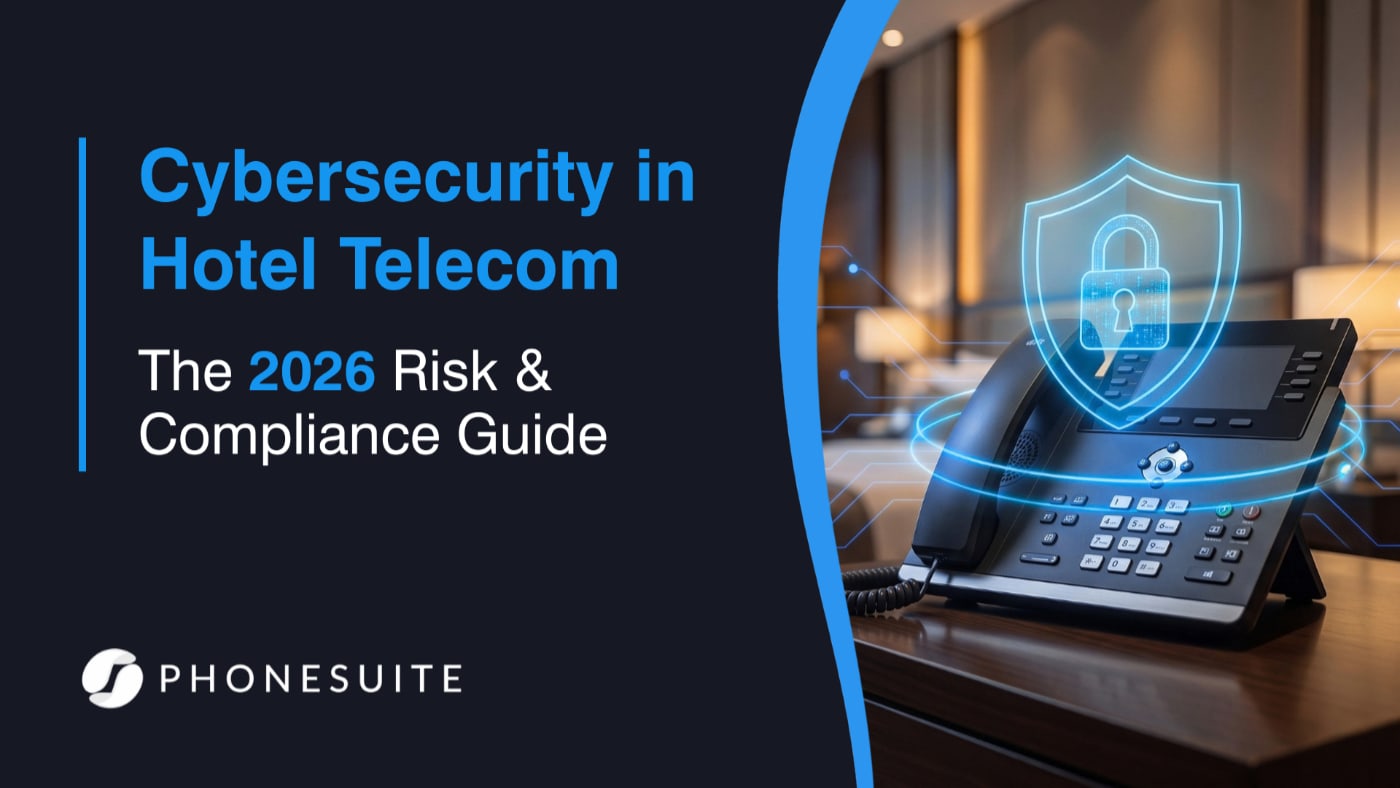
When reviewing a hotel’s security checklist, you’ll see key cards, hall cameras, Wi-Fi firewalls, and payment processing on the list. Notice what’s missing? The phone system. Because room phones sit in the background and rarely ring for guest calls, teams assume they’re harmless, but cybercriminals still target them.
In this blog, we’ll show you how modern phone systems get targeted and how Phonesuite can help keep your network secure.
Late Night Front Desk Scam
A guest’s room phone rings at 2:00 am and the caller claims to be the front desk, stating that the card on file was declined and asking for updated information. Half-asleep, the guest reads off their credit card details. The call didn’t even come from the front desk; it came from an outside scammer.
The solution to this problem is to block direct outside dialing to guest rooms by default. When every incoming call must pass through the front desk first, the scammer loses their entry point.
Stolen Credentials & Toll Fraud
Toll fraud occurs when attackers breach your system to route thousands of costly international calls over time, leaving you with exorbitant charges. In this case, hackers typically target two things:
- SIP Trunk Credentials: The grand prize that allows hackers to make calls as if they represent your hotel.
- Extension Credentials: This allows hackers to hijack individual room phones.
The fix for this involves modern hosted platforms like ConnectWare, which hide trunk credentials, assign randomly generated passwords to each phone, require multi-factor authentication (MFA) for technicians, and actively block automated forced login attempts.
Voicemail Back Door
On traditional legacy systems, hackers can dial a voicemail box and guess a weak PIN to remotely forward expensive international calls through the hotel’s lines.
The solution is to disable remote call forwarding and outbound dialing through voicemail, and to ensure guest mailboxes are automatically wiped clean at checkout.
Securing What’s On-Site
Typically, on-premise PBX hardware sits in a back room, leaving it vulnerable to anyone with physical or network access. With hosted cloud platforms, there is virtually no hardware on-site at risk of attack.
To solve this problem:
- Assign unique and random passwords to physical phones and analog gateways.
- Disable on-device web interfaces to prevent local users from tampering with settings.
- Isolate your network by keeping voice traffic on a dedicated VLAN completely separated from guest Wi-Fi.
International Toll Fraud
To prevent guests or visitors from incurring charges directly from room phones, set sensible default restrictions by blocking high-cost international calls, and maintain a blocklist of known fraud targets, including suspicious area codes and domestic 900 numbers.
E911 Compliance & Guest Safety
An important part of security is ensuring your guests can receive help in an emergency. Federal law mandates these two critical protections:
Kari’s Law: Requires direct-dial 911 access without dialing a prefix (like “9”) and immediate notification to the front desk.
RAY BAUM’S Act: Mandates that the exact “dispatchable location” details (building, floor, and room numbers) be passed to 911 dispatchers.
8 Questions to ask your phone provider:
-
- Is direct outside dialing to guest rooms blocked by default?
- Are trunk credentials completely hidden from end-users?
- Are passwords unique and randomly generated?
- Is multi-factor authentication required for admin access?
- Is international and premium calling restricted by default?
- Is the system monitored 24/7 for unusual call spikes?
- Is voice traffic kept isolated from guest Wi-Fi?
- Does the platform fully meet Kari’s Law and RAY BAUM’S Act E911 requirements?
The phone on the nightstand might not get as much use as it typically does, but it remains directly connected to your guests, your staff, and your hotel’s profits. It deserves a main spot in your security strategy.
Is Your Hotel Telecom Fully Protected & Compliant?
Don’t wait for an expensive incident or E911 audit failure to discover vulnerabilities in your network. Schedule a complimentary 15-minute security and compliance review with a Phonesuite specialist today.
Talk to a Hospitality Voice Specialist
_
Frequently Asked Questions: Hotel Telecom Cybersecurity
How do scammers place fake “front desk” calls directly to hotel guest rooms?
What is SIP toll fraud, and how does it impact hotel phone systems?
How can hosted cloud PBX platforms prevent credential theft and toll fraud?
Can hackers use hotel voicemail systems to make unauthorized international calls?
Why should hotel voice networks be separated from guest Wi-Fi?
What are Kari’s Law and RAY BAUM’s Act, and how do they apply to hotel phone systems?
- Kari’s Law says anyone must be able to dial 911 directly without pressing “9” first, and the system must alert the front desk immediately when an emergency call goes out.
- RAY BAUM’s Act requires the phone system to send exact “dispatchable location” info, including building, floor, and room number, straight to 911 dispatchers.
What steps can hotels take to block unauthorized international calling from room phones?