Telephony is a critical part of any business. It’s how we communicate with our customers, vendors, and partners. In the past, the only way to get telephone service was through analog technology. But in recent years, digital and IP telephony have become more popular. So, what’s the difference between these technologies? And which one is right for your business?
In this blog post, we will explore the differences between analog, digital, and IP telephony, and help you decide which one is best for you!
Key Takeaways
- Analog telephony (POTS) sends voice over copper lines using electrical signals. It’s simple and affordable, but less efficient, harder to scale, and more prone to noise or quality loss.
- Digital telephony (often ISDN) converts voice into numbers for clearer calls and better long-distance quality, but it needs dedicated equipment like a KSU and can cost more.
- IP telephony (VoIP) sends calls over internet protocols, making it highly scalable and feature-rich, with support for modern tools and easier expansion.
- The right choice depends on budget, bandwidth, and feature needs. For most businesses and hotels, VoIP is the modern standard, and providers like Phonesuite can support cloud or on-prem setups, including mixed VoIP and analog rooms.
Digital Phone System vs VoIP: A Brief Comparison
Digital phone systems transmit voice as digital signals and can scale line capacity with minimal added hardware in many setups. VoIP (voice over internet protocol) is digital telephony delivered over your internet connection, sending voice as IP data. VoIP has become the commercial standard largely because it supports richer features and easier management.
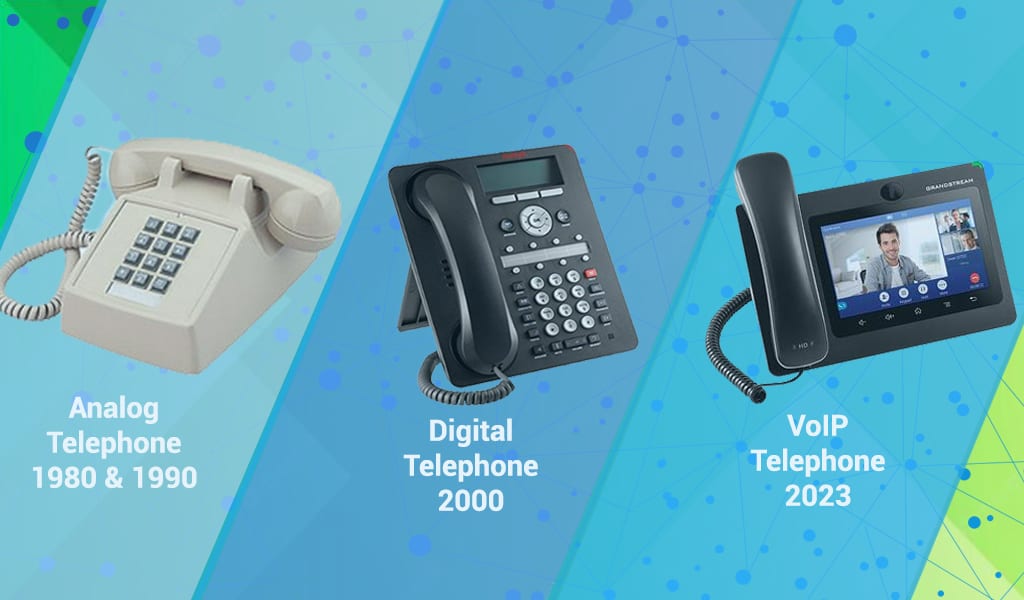
Analog Telephony, or POTS
Analog telephony has been around for decades. It uses an analog signal to transmit voice data over a traditional phone line. Analog telephony is reliable and easy to use, but it Recommendationas some drawbacks. One of the biggest disadvantages of analog telephony is that it is not very efficient. Because it uses an analog signal, there is a lot of room for error. This can result in static, dropped calls, and other problems. Additionally, analog telephony is not very scalable. If you need to add more phone lines, you will need to install more equipment.
Plain old telephone service, or analog telephony, utilizes the constrained RJ-11 socket to handle your regular phone, fax machine, and modem. Analog telephony is sometimes referred to as POTS. When using analog technology, audio (such as your voice) is converted into electrical pulses. You most certainly have an analog phone at home or are accustomed to using one. Since it has been around the longest, this technology is also the most affordable. Although it is inexpensive, analog has a cap on the amount of data that can be transferred. As a result, if your company has a large number of employees, you probably need to use a VoIP system, which we’ll cover in more detail later.
Digital Telephony, or ISDN
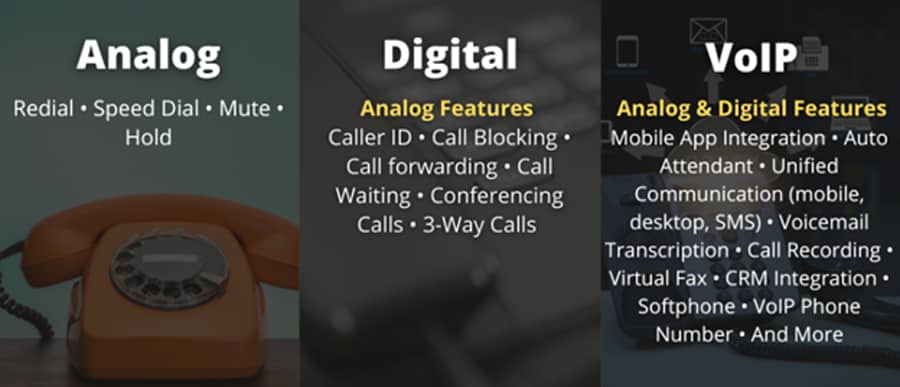
Digital telephony uses a digital signal to transmit voice data. Digital telephony is much more efficient than analog telephony, and it is also more scalable. You can add more phone lines without having to install additional equipment. Additionally, digital telephony offers features that are not available with analog telephony, such as caller ID and call waiting. However, digital telephony can be more expensive than analog telephony, and it requires special equipment.
Digital telephony is more beneficial to your company than analog, and as was already said, it can send more data. Additionally, whereas digital transmissions maintain their quality over great distances, analog signals do not. This is due to the way that digital technology functions, which encodes audio into numbers at one end and decodes those numbers back into audio at the other. The advantage of using digital telephones is that the audio encoded at one end and decoded at the other end is identical. A key service unit, often known as a KSU, is essential for digital phones in order to function.
IP Telephony, or VoIP
IP telephony uses the Internet Protocol (IP) to transmit voice data. IP telephony is very efficient and scalable. You can add more phone lines without having to install additional equipment. Additionally, IP telephony offers features that are not available with analog or digital telephony, such as VoIP (Voice over IP). However, IP telephony can be more expensive than analog or digital, requiring special equipment.
VoIP, or voice over internet protocol, telephony, uses the internet to make phone calls rather than traditional phone networks. VoIP is actually a form of digital telephony, and since it offers so many more features than its forerunners, it has become the current commercial standard for phone systems. Since companies may now use their computer or IP phone to conduct phone calls, convenience and affordability are two important elements in the VoIP revolution. It’s crucial to note that analog phones utilize the smaller RJ-11 socket, but IP telephony uses the larger/wider RJ-45 Ethernet plug.
The various telephone technologies and their functions are just briefly covered in this article. We invite you to conduct further studies on a particular technology or to get in touch with us if you have any queries. You should remember after reading this article that selecting the proper technology will be heavily influenced by your budget and bandwidth requirements.
IP telephony, or internet protocol telephony, refers to a system that uses internet protocols to transmit voice, video, and other forms of communication over a network. This includes voice over IP (VoIP) systems, which are used to make phone calls over the internet, as well as video conferencing and other types of communication.
So, which type of telephony is right for your business? If you need a reliable and easy-to-use solution, analog telephony may be the best choice. If you need a more efficient and scalable solution, digital or IP telephony may be the better choice. And if you need the most features and flexibility, IP telephony may be the best option. Whichever type of telephony you choose, make sure you partner with a reputable provider who can offer the services and support you need.
Recommendation
One key difference between analog and digital telephony is the quality of the signal. Analog signals can be prone to interference and degradation, while digital signals are generally more stable and provide higher quality audio. IP telephony offers additional features and capabilities, such as the ability to make calls over the internet and integration with other forms of communication and collaboration tools.
We know that upgrading can be scary, but when it comes to bringing your phone system into the 21st century (and beyond), a VoIP system is about as painless as it gets. If you’re curious about the cost, the installation progress, and what a new phone system can do for your hotel, get in touch with Phonesuite today! We’ll explain the product, the process, and how you can get started on an upgrade.
As a leading hotel PBX system and communications provider for over 25 years, Phonesuite remains 100% dedicated to the hotel industry. Our modern, flexible innovative hotel communication solutions offer hotels the choice between cloud-hosted and on-premise PBX platforms that support both VoIP and analog guest room phones utilizing the same feature-rich software for all installation types. Our SuiteSIP trunking solution offers significant cost savings over traditional T1/PRI services and is designed around the unique needs of hotels. We get you talking!
Analog vs Digital Phone vs IP Phone FAQs
Is VoIP the same as a digital phone system?
Not exactly. VoIP is a form of digital telephony, but “digital phone system” often refers to non-VoIP digital systems that use traditional phone infrastructure. VoIP routes calls over your IP network and the internet, while classic digital systems use digital signaling over dedicated phone lines.
What is the difference between VoIP and digital phone systems?
VoIP sends calls as data over an IP network (internet or private network). A “digital phone system” usually means a PBX that uses digital signaling over dedicated phone lines or internal wiring, not necessarily internet-based.
Which is better for features, digital phone systems or VoIP?
In most business setups, VoIP offers more features because it is built on IP networking. Common advantages include easier administration, integrations, and modern calling capabilities. Traditional digital phone systems can be reliable and straightforward, but they often have fewer advanced features.
Which is easier to scale with more lines?
It depends on the setup, but digital telephony can often add lines without extensive new equipment, especially in environments already built for it. VoIP scaling is usually straightforward too, but it may require adequate network capacity, proper configuration, and sometimes upgraded network hardware.
What happens during an internet outage with VoIP vs digital phone systems?
VoIP calling is affected if your internet or IP network goes down, unless you have redundancy (backup internet, failover routing, mobile forwarding). A traditional digital phone system may keep internal calling more stable and may be less dependent on the data network, but it can still be impacted by power and carrier issues.
Why are landlines switching to digital?
Phone carriers are retiring old copper networks because they’re expensive to maintain. Digital (IP-based) service is easier to scale, supports modern features, and runs over fiber, cable, or broadband instead of legacy analog lines.